Polar Glacier Environment Creation
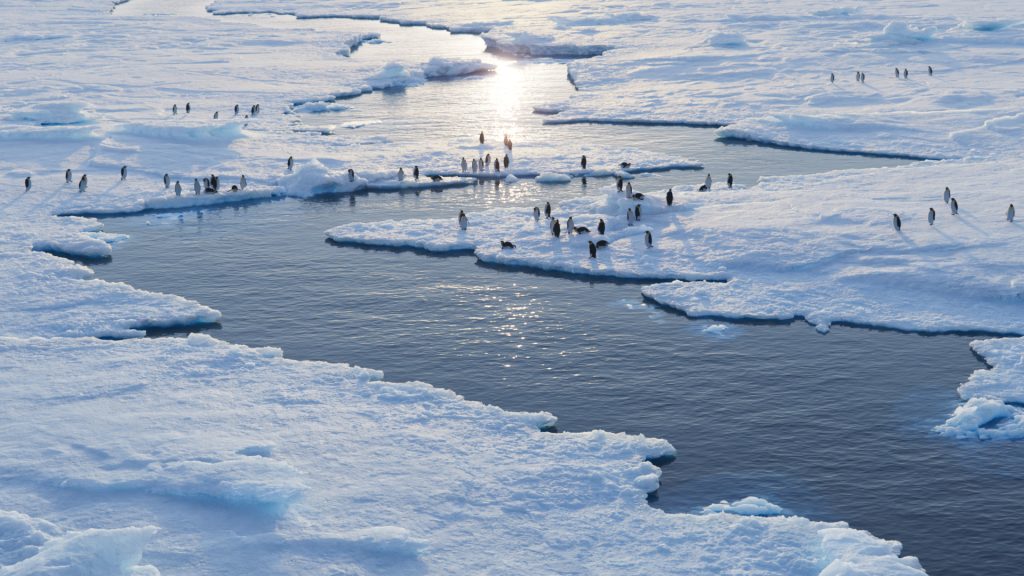
The core objective of this project is to demonstrate how Geometry Nodes can be used to optimize the foundational structure of large-scale environments while combining manual fine layout control to achieve a cinematic visual result.
3D Production
1. Core Technology: Mesh-Driven Procedural Terrain
The heavy glacier formations seen in the scene are fundamentally generated from an extremely simple low-poly plane.
Procedural Detail Generation
Using Geometry Nodes, we built a procedural logic system on top of the base plane to automatically generate:
* physical ice thickness
* side extrusion cracks and crevices
* natural melting erosion marks
* crystalline surface textures
This approach replaces labor-intensive manual sculpting while allowing large-scale assets to retain very low polygon counts with rich visual detail.
2. Materials & Lighting: Physically Based Approach
Optical Material Reconstruction
For the glacier material, particular attention was given to Subsurface Scattering (SSS) to simulate how light refracts and is absorbed within ice crystals, restoring the characteristic translucent density and softness unique to polar ice.
3. Artistic Control: Manual Layout & Composition
To ensure correct visual storytelling, several scene elements were manually art-directed.
“The positioning of the penguins and the density distribution of floating ice on the water surface were manually arranged to ensure that perspective, visual balance, and color distribution followed cinematic composition principles.
This avoids the visual noise often introduced by purely random procedural placement.
Through deliberate arrangement of individual assets—such as varying penguin poses—we recreated believable social behaviors of wildlife in a polar habitat, significantly enhancing scene realism.
Compositing
The final visual result was not achieved through raw rendering alone, but through a layered render compositing workflow.
The original 3D render primarily provided the base geometry relationships and lighting structure, while compositing was used to elevate the final output to a cinematic and photorealistic standard.”
ACES Workflow Integration
The entire compositing pipeline follows the ACEScg color workflow.
This ensures that highlights remain controlled even under extreme exposure conditions—such as direct sunset reflections on water—while preserving shadow latitude and enabling smooth transitions from the cold glacier tones to warm sunlight hues.
This workflow also eliminates the color banding and harsh tonal transitions often present in raw 3D renders.
The original render lighting was technically correct but visually flat.
In compositing, we used Multi-Pass Light Groups to perform secondary light design.
Particular emphasis was placed on:
* enhancing glancing sunlight
* improving specular scattering on the water surface
This makes the highlight bloom on the water more natural and richly detailed.
Medium Interaction Enhancement
The three key materials—ice, snow, and water—were treated separately during compositing.
Hard ice edges from the raw render were softened with subtle Glow and Diffuse, giving them a more translucent, hydrated appearance while emphasizing the SSS behavior of ice.
Water surface details were refined by reconstructing the reflection and refraction passes, eliminating the “plastic” look commonly found in raw CG renders.