African Savannah
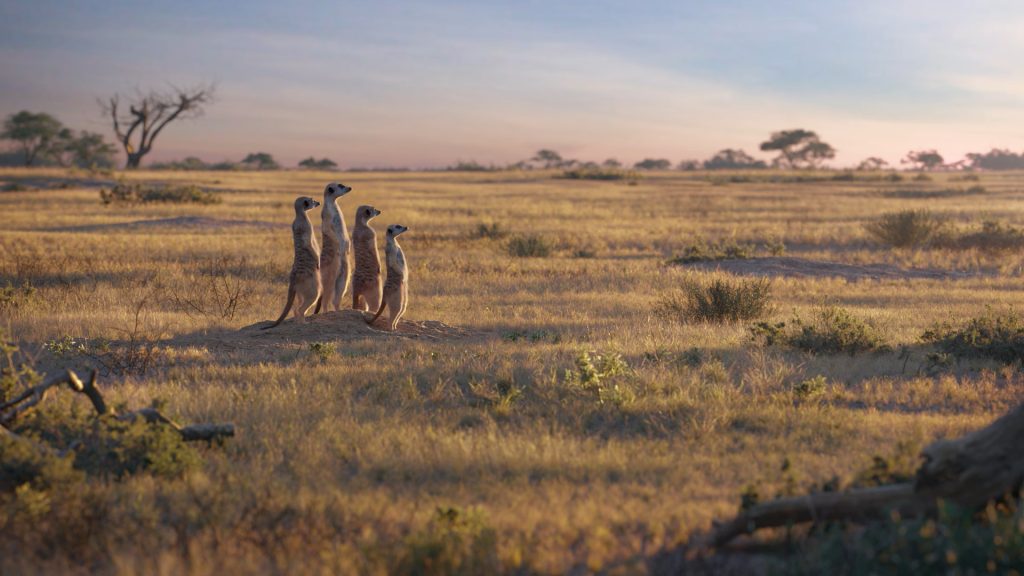
This project follows a film-grade production pipeline, combining manual sculpting, layered displacement, and Geometry Nodes–based micro-terrain generation to construct high-fidelity environmental detail.
Vegetation distribution is controlled through a procedural system, while scene optimization strategies—such as camera frustum culling and viewport optimization workflows—ensure stable performance when handling large-scale environments.
Rendering is performed in Blender’s Filmic color management pipeline, outputting multi-pass OpenEXR data. Using Cryptomatte and Light Groups, we achieve precise, layered compositing with fine-grained control.
The final result captures a believable and grounded moment within a natural wildlife environment.
1. Environment & Layout
Foreground Micro-Terrain Development
Primary landforms are established through manual sculpting, while layered displacement is used to build multi-scale surface detail.
Geometry Nodes are employed to generate fine granular breakup, scattered dry branches and rocks and debris. These elements enhance surface complexity and environmental realism.
Procedural Ecosystem Distribution
A Geometry Nodes–driven distribution system is used in combination with manual weight painting, allowing for localized control over the vegetation scale, density variation and directional growth patterns.
2. Scene Optimization
While pursuing visual fidelity, performance optimization remains a core consideration.
By implementing highly efficient instancing workflows within Geometry Nodes, memory usage and render overhead are significantly reduced.
Even with thousands of static and animated vegetation elements, the scene remains responsive through
camera frustum culling, viewport display optimization and proxy-based workflows.
3. Lighting & Look Development
Multi-Light Setup
Multiple lighting setups are explored within the same scene to achieve a more refined and stylized visual result, while maintaining physical plausibility.
Filmic Color Management Pipeline
The project utilizes Blender’s Filmic color management, configured via OCIO (OpenColorIO), ensuring color consistency from texture input to final 32-bit OpenEXR output.
This workflow preserves highlight roll-off and maintains maximum dynamic range for downstream compositing.
Multi-Pass AOV Workflow
Light Groups
Separate outputs for key light, fill light, and rim light allow full relighting control in compositing without the need for re-rendering.
Cryptomatte
Using material ID–based masking, Cryptomatte enables precise, pixel-accurate isolation of elements such as the meerkat group and background vegetation for targeted color grading.
Depth Pass (Z-Depth)
Depth data is used in compositing to reconstruct atmospheric perspective, with subtle introduction of light scattering effects to enhance spatial depth and air density.
4. Post-Production & Compositing Pipeline
Using the Z-Depth pass, atmospheric perspective is refined to enhance spatial clarity and depth layering across the savannah. Using Cryptomatte, we achieve precise, localized color grading.
Through Light Groups, lighting balance is re-adjusted in compositing to emphasize low-angle morning sunlight.
A subtle Bloom effect is introduced to simulate real lens response and enhance cinematic quality.
Finally, a linear color workflow transforms the physically accurate render into a warm, narrative-driven golden-hour moment, bridging the gap between technical output and artistic storytelling.